


Where Does Noise in Ceramic Pumps Come From? Four Structural Optimizations to Reduce High-Frequency Noise
Normally, a ceramic pump generating high-frequency sounds does not indicate that it has failed. What you hear is a resonance operating. The sound is a continuous "zzz--" or "eeek--" which is loud enough to penetrate a wooden cabinet and reach your ears. The sound does not actually come from the ceramic component; it originates from the combination of engineering and hydraulics functionality.
The main culprit is rotor-stator interaction between the impeller and the pump casing. As the impeller blades sweep past the volute tongue, they periodically squeeze the fluid, creating pressure pulsations. That pulsation frequency-blade count times rotational speed-is the fundamental source of the high-frequency noise. A ceramic impeller is stiff and lightweight, so it actually responds more sensitively to this excitation, transmitting vibration more efficiently than a metal impeller.
The second layer comes from micro-vibration in the bearing and shaft sleeve. Ceramic sleeve surfaces are very smooth, but if the clearance with the mating bearing isn't matched properly, or if fine particles are present in the fluid, the shaft system will produce small high-frequency tremors that radiate as a sharp sound through the pump body. The third layer is acoustic radiation from the pump housing. To resist corrosion, ceramic pump housings tend to be thin and hard-rigid enough but under-damped-so internal pulsation energy gets amplified by the housing into airborne noise.

Four structural fixes to knock down the high frequency
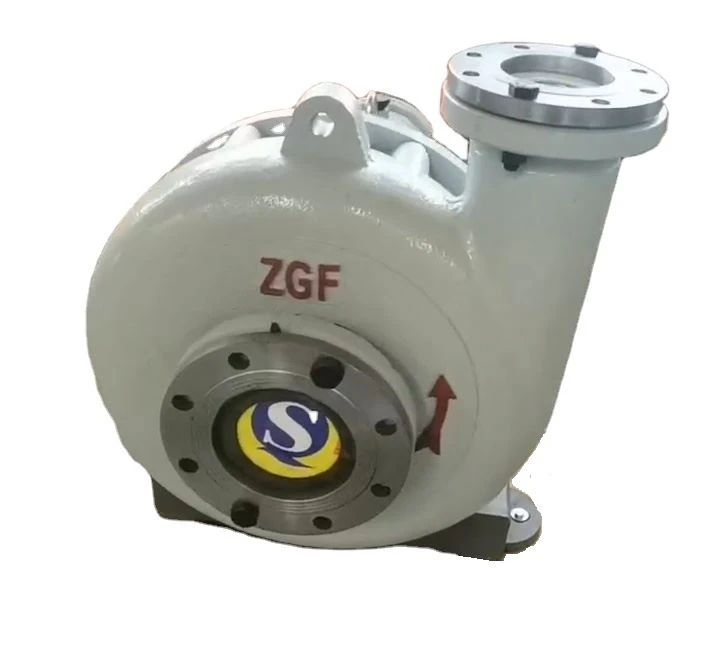
First method is to fix gap between impeller and volute tongue. The distance between impeller and tongue outer diameter directly determines the levels of pulsation amplitude. If the distance is less-than-it-should-be, the pulsation peaks will be high. If the distance is large enough, for example, over 10 mm, the pump efficiency will drop. The rule of thumb here is to increase the angle of the volute tongue because maximum drop in pulsation level will occur if the liquid flow transition from impeller to volute proceeds smoothly. Measurements show that changing the angle of the volute tongue from 25 to 34 degrees allows to reduce the vibration level of the pump by more than half.
Two staggered-frequency style at the impeller output. If every blade were evenly spaced, it would produce all of its vibrating energy in one striking frequency that would generate a loud noise. By making the exit blade sections ununiformly arranged, or slight changes made to the shape of the tips and trailing edges, the needed high-frequency energy would be dispersed over a broader area. Humans can stand the nonspecific noise much better than the pure sound resulting in reduced volume. With a ceramic impeller this can be done automatically during the process of shaping by using no tooling.
The third option is to incorporate damping into the shaft system. As ceramic shafts and bearings are hard-on-hard contact components, they cannot enjoy the cushioning effect of metal pumps thanks to oil films or polymer bushings in the pump system. Some options to reduce the amount of high-frequency vibration transferred to the pump housing include using a thin layer of polymer covering the ceramic shaft or converting the bearing housing into floating bearings with elastic isolation. The only condition is that the sleeve should be able to withstand the pumped medium. In case of running clean water or mildly aggressive liquids, PEEK or modified PTFE can be used.
Four using constrained-layer dampers on a pump's housing. Ceramic housings are inherently very poorly damped, which means they resonate loudly after being set into motion, like bells. Without causing any disruption in flow passages, constrained-layer dampers can be used at the surface of the housing with just the outer side being treated or rubber grooves can be created during manufacturing of the non-wetted surfaces and then filled with high-damping metals or polymers. It should be noted that this layer ensures that no contact with the fluid happens, and therefore only the energy of vibrations in the housing is converted into heat.
High-frequency noise is hard to treat because the answer isn't blocking it-it's spreading it and absorbing it. The structural optimization mindset isn't to eliminate vibration entirely, but to keep it from settling at the frequency band your ears are most sensitive to. Stack these four approaches, and a ceramic pump's high-frequency whine typically goes from piercing to noticeable but not annoying.


