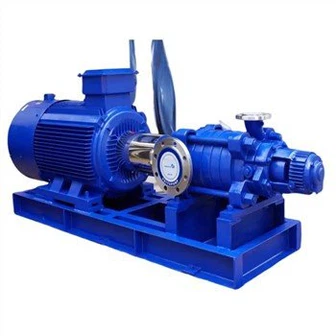
Adjustment Of Slurry Pump Flow
1. Export throttling
For slurry pumps, this is a universal and inexpensive flow adjustment method. Usually this method is only used on slurry pumps. Partially closing any type of valve on the outlet pipeline will increase the system pressure head, so the system pressure head curve will intersect the slurry pump pressure head curve at a smaller flow rate. The outlet throttling moves the operating point to a lower efficiency point, and there is a power loss at the throttle. This may be important for large pump installations, and adjustment methods with higher investment may be more economically attractive. Throttling to the dead point may cause the fluid in the pump to overheat. You can use a bypass to maintain the necessary small flow, or use different adjustment methods. This is very important for the aforementioned pumps that handle hot water or volatile liquids.
2. Throttle at the suction port
Then in the suction pipeline, some power can be saved by throttling. Because outlet throttling can cause overheating or vaporization of the liquid, jet engine fuel slurry pumps often use inlet throttling. At a very small flow rate, the impeller of these pumps is only partially filled with liquid. Therefore, the input power and temperature rise are about 1/30 of the full operating position of the impeller when the outlet is throttled. The flow rate of the condensate pump is usually controlled by the submergence depth. Equivalent to inlet throttling. The special design can reduce the cavitation damage of these pumps to an insignificant degree, but the energy level has also become quite low.
3. Bypass adjustment
From the discharge pipeline of the slurry pump, all or part of the flow can be divided and led to the suction port of the pump or other appropriate points through the bypass pipe. One or more flow orifices and suitable control valves can be installed in the bypass. Metering bypass is usually used to reduce the flow of the boiler feed pump, mainly to prevent overheating. If the excess flow of the bypass propeller pump is used to replace the outlet throttling, considerable power can be saved.
4. Speed adjustment
When this method is used to adjust the flow, the required power can be reduced to a minimum, and the overheating phenomenon in the flow adjustment process can be eliminated. Steam turbines and internal combustion engines can easily adapt to speed regulation with a small additional cost. Various mechanical, magnetic, hydraulic speed change devices and DC and AC variable speed motors can all be used to adjust the speed. In general, variable speed motors are too expensive, and adjustable blade adjustments can only be used when economic studies on special circumstances prove to be worthwhile. After studying the adjustable guide vane installed in front of the impeller, it is found that this method is effective for the adjustment of the pump when the specific speed = 5700 (2.086). The blades can produce positive pre-rotation, thereby reducing head, flow and efficiency. However, only relatively small adjustment effects can be obtained by the blades. Large-scale energy storage pumps used for power generation in Europe have successfully applied adjustable outlet diffuser blades. The propeller pump with variable pitch blades has also been successfully studied. In the case of constant pressure head and relatively small efficiency loss, a large flow rate variation range can be obtained. But these methods are too complicated and expensive, so they are greatly restricted in practical applications.
5. Invigorate
Supplementing air to the suction port of the slurry pump is also a method of adjusting the flow rate. This method can save some power compared with the outlet throttling. Generally, it is not desirable to have air in the liquid being transported, and there is always a risk of the pump losing its filling head if there is too much air. Therefore, this method is rarely used in practice except for some occasions.