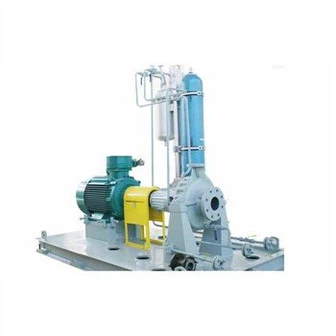
Ceramic Slurry Pumps Vs. Rubber-lined Pumps Vs. Stainless Steel Pumps: Lifespan Comparison Under Abrasive Conditions
In abrasive slurry service, pump life is not really about a single wear rating. It comes down to how quickly the wetted surfaces lose material under cutting, impact, and corrosion acting together. Ceramic, rubber, and stainless steel take different approaches, and their relative life depends on how each material responds to particles-not on hardness alone.
-
For the wetted parts of ceramic slurry pumps, you typically use alumina or silicon carbide. These ceramics are significantly harder than typical abrasive solids like quartz and feldspar. With the slow, smooth flow of fine particles, however, the particles do to not plow channels into the surfaces and liners and impellers can operate for long periods with negligible dimensional change. The tradeoff is brittleness. Ceramic can chip or craze from large rocks, tramp metal, water hammer or cavitation. After initiating crack, the mode of failure is no longer slow wear but sudden fracture. The only other exception is thermal shock where the ceramic lining cracks and separates from the metal shell. It stands to reason that ceramic works best in low-impact, continuously flowing service with fine particulates.
-
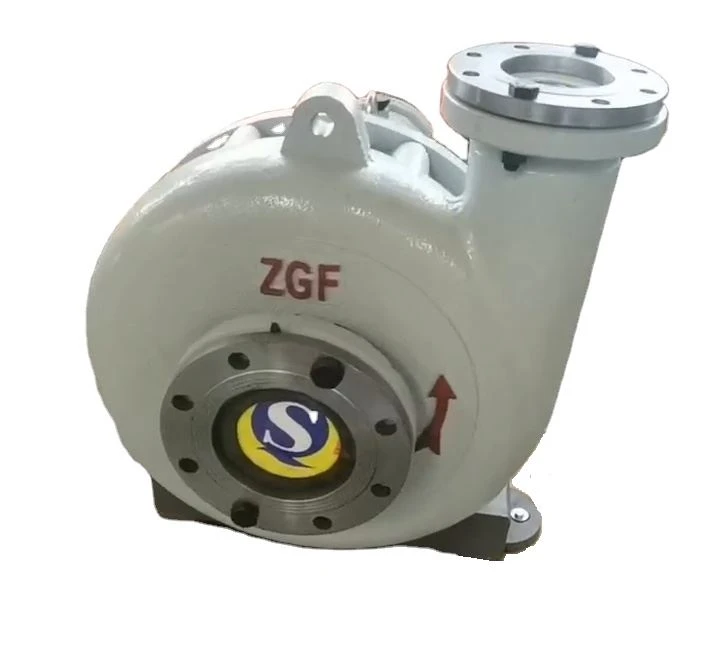
Rubber-lined pumps function by allowing the rubber compounds to flex and absorb the shock of impact. As particles strike the pump surface, the rubber lining deflects and springs back, dissipating the energy rather than cutting into the surface material. With fine and rounded particles, the right velocities, and working temperatures of up to around 70 °C, rubber linings can have a long life, but with sharp, angular materials like crushed quartz and glass, the rubber can be gouged. Once a gash appears in the rubber lining, the slurry penetrates and unseals it. Heat, oil, and corrosive chemicals wreck rubber linings by making them hard and brittle.
-
Stainless steel is usually at a disadvantage in abrasive service. Austenitic grades are around 200–300 HV, while quartz and alumina can exceed 1000 HV, so hard particles simply cut the base metal. Duplex or martensitic grades are somewhat harder, but the improvement is limited. Stainless is a better fit when corrosion dominates and abrasion is mild, such as acidic or chloride-containing slurries. Some austenitic grades work-harden under heavy impact, but the hardened layer is thin and does not provide much protection against continuous cutting. With soft particles and low solids, stainless wetted parts can still give acceptable life and avoid ceramic cracking or rubber aging concerns.
When all three are compared in the same slurry, the real drivers are particle hardness, particle size and shape, velocity, temperature, pH, and impingement angle. A fine, high-velocity tailings slurry may run several times longer with a rubber-lined pump than with stainless steel. A coarse, hard-particle slurry will show very little ceramic wear, provided large tramp material is kept out. A strongly corrosive slurry with only light abrasion is often safer with stainless. Failure modes also differ: ceramic tends to fail suddenly by cracking, rubber by cutting or aging, and stainless by gradual wall thinning, so maintenance strategies need to match.
In practice, "abrasive service" alone is not enough for selection. You need the specific particle hardness, size distribution, slurry temperature, pH, velocity range, and whether large-particle impact is possible. Those variables determine which material lasts longer. Each material has a working window, and once the service moves outside that window, its original advantage disappears quickly.